

You have a date, a venue, and a rough idea of what the room needs to do. You send that to three suppliers and get back three quotes that are impossible to compare, because each one guessed differently about the things you did not mention.
That is not the suppliers being difficult. It is what happens when a brief leaves the important variables open. Every gap gets filled with an assumption, and assumptions get priced defensively.
Here is what to send instead.
The venue, named, with the room
Not the city. The building and the specific room, because a supplier who has worked in it already knows the ceiling height, the power position, the dock situation, and whether the freight elevator will take a road case. Half the questions in a first call disappear when the room is named.
If the room is not booked yet, say so and name the shortlist. A supplier can tell you which of the three will cost you less to build in, which is worth knowing before you sign the venue rather than after.
Your access times, not your show times
The show time is the easy part. What decides the build is when your crew can get into the room, and when they have to be out.
Tell us the load-in window, the load-out window, and whether either one is shared with another event. A room that is available from six in the morning is a different job from the same room available from noon, even though the show starts at the same hour. If the venue has a hard curfew, that is a load-out constraint and it changes the crew size.
What has to happen in the room, in order
A running order beats a description of the event. Doors, welcome, keynote, panel, break, awards, band, out. Rough timings are fine and rough is genuinely fine at this stage.
The order matters because changeovers are work. A panel that follows a keynote on the same stage is one setup. A panel that follows a keynote and has to be struck for a dinner in the same room is three setups and a crew that stays late.
The headcount, and the shape of the room
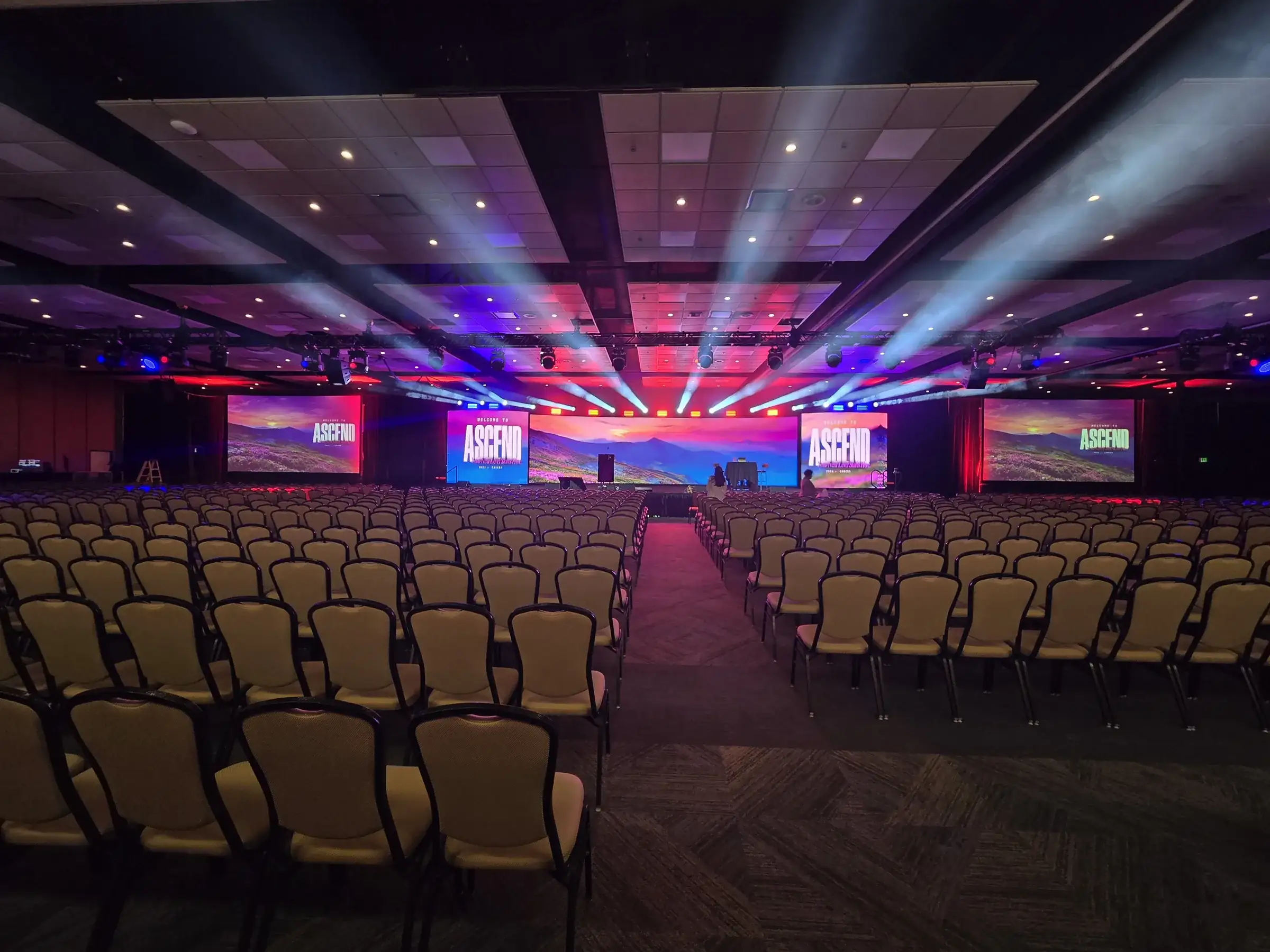
Four hundred people seated in rows is not four hundred people at rounds. The seating plan drives the audio coverage, the sightlines, and whether you need image magnification at all.
If you do not know yet, give the range you are working within. A supplier can price the middle and tell you where the number stops being free.
Anything arriving that is not yours
Presenter laptops, a band with its own engineer, a video crew from the client's agency, a sponsor who wants a screen in the foyer, a livestream someone else is running. These are the items that turn up on the day and need a cable nobody planned for.
They are not a problem when they are on the list. They are a problem when they arrive at four in the afternoon.
What you are actually worried about
This is the one most people leave out, and it is the most useful line in the email.
If the thing keeping you awake is that the CEO's video has to play cleanly, say that. If it is that last year the audio was unintelligible at the back, say that. If it is that the room has to turn around in forty minutes and nobody believes it can be done, say that.
A supplier who knows what you are worried about will build the answer to it. A supplier who does not will build to the spec and be surprised, alongside you, at the moment it matters.
Why this is worth twenty minutes
A brief with these six things in it comes back as a quote you can actually compare against another quote, because the suppliers are pricing the same event rather than six different guesses at it.
It also moves the conversation forward instead of sideways. The first reply becomes a question about the work rather than a request for the information you would have sent anyway.
And it lowers the contingency. A supplier pricing an event with open variables has to cover the worst reasonable version of each one. Closing the variables is the cheapest thing you can do to a quote, and it costs an email.
The short version
Send the room, the access windows, the running order, the headcount and seating shape, the list of things arriving that are not yours, and the thing you are worried about.
Everything else can be worked out on a call.