
Direct answer
There is no single certification that proves an AV technician is any good, so start with safety rather than badges. Ask for documented safety programs, liability and workers' compensation coverage, and the specific tickets the work requires: rigging and fall protection, lift and forklift certification, and qualified people for temporary power. Then ask about experience, because that is the part no certificate covers and the part that decides your event.
Start with safety, not badges
Most buyers look at equipment, price, and past events. The thing that is easiest to overlook is whether the company can work safely in your venue.
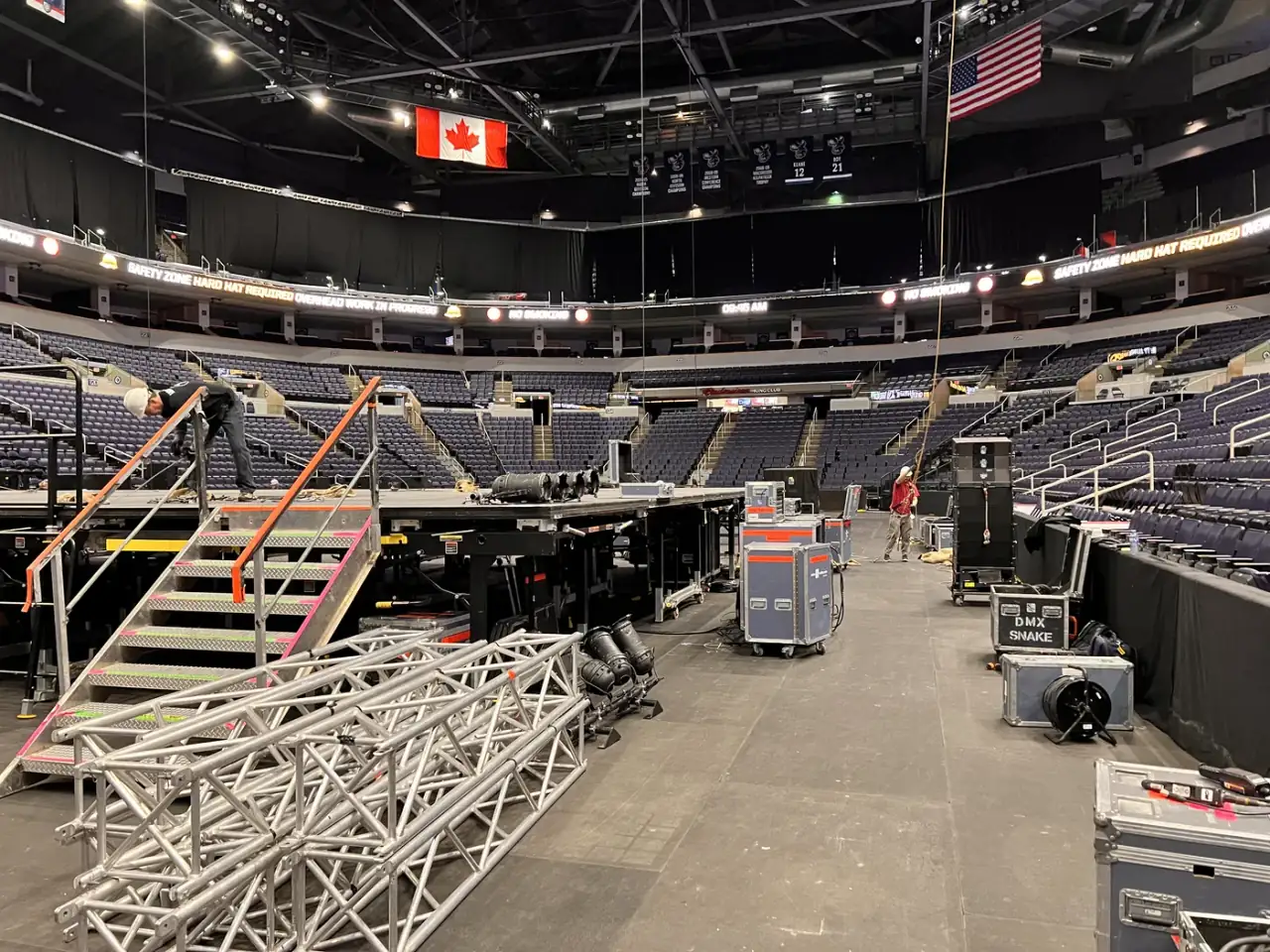
Event production happens around suspended loads, temporary electrical distribution, lifts, forklifts, staging, and temporary structures, usually at speed, usually overnight. The audience sees a finished room. Setup and strike are where the risk lives.
At a minimum, expect:
- Documented workplace safety training and hazard awareness
- Emergency response procedures
- Liability coverage and workers' compensation
- Compliance with local occupational health and safety regulation
- A culture that puts safety ahead of speed, which you can hear in how they answer the question
The certifications the work actually requires
Which of these apply depends on your event, but ask which ones the company holds:
- Rigging certification and fall protection, for anything hung from the roof
- Forklift and material handling
- Elevated work platform and lift operation
- Electrical qualification and permitting, for temporary power distribution
- Venue-specific safety orientation, which many buildings require before anyone starts
What happens when they are missing
This is not paperwork. In many venues and jurisdictions, work can be delayed or stopped outright when the right certifications or permits are not in place.
The usual causes are electrical work done by unqualified people, rigging installed by uncertified crew, lifts operated by somebody without a ticket, and failure to follow venue rules. The result is lost hours during load-in, added cost, a compressed schedule, and a lot of stress that has nothing to do with your event.
Equipment training is a separate question
Safety training says somebody can work without getting hurt. It does not say they can run your show.
Digital audio consoles, media servers, LED processing, lighting control, and show networking each require their own training. Most manufacturers run certification programs on their own platforms. Ask whether the technician assigned to you is trained on the specific equipment in the proposal.
It is usually obvious within an hour when somebody is learning a console on your event. You should not be paying for that.
The honest part: no certificate makes a good technician
Unlike some professions, there is no universally recognized credential that guarantees skill in this industry. Most of what separates a strong technician from an adequate one is accumulated experience.
So ask:
- How long has this technician worked in live events?
- What kinds of productions have they done?
- Have they run events like mine?
- Can you show me comparable projects?
Somebody who has programmed and operated hundreds of live shows brings judgement that no course teaches, and it shows up precisely when conditions change.
The industry credential worth knowing
The most widely recognized is certification through AVIXA, which is respected across the global audiovisual industry. Beyond that, manufacturer certifications on specific platforms are a reasonable signal of ongoing professional development.
Neither replaces a track record. Both are worth asking about.
Our take
The best companies combine four things: safety, training, experience, and accountability.
Safety comes first. The most impressive equipment package in the world means nothing if somebody gets hurt building it, or if the audience is put at risk.
In live events there are no practice games, and that is meant literally. When the doors open, when the keynote walks on, when the broadcast goes live, there is no second attempt. That is why experience carries so much weight. Certifications are the foundation. Experience is what lets somebody make a good decision at 4 p.m. when something has changed.
Technology has changed enormously. The constant is that events are delivered by people. The best technicians never stop learning, and they build the judgement one show at a time.
The bottom line
Look for strong safety programs, real insurance, compliance with local regulation, the specific technical certifications your event requires, manufacturer training on the actual equipment, and technicians with a track record you can check.
Certifications demonstrate competency. Experience demonstrates capability. In an industry with no practice games, you want both.