



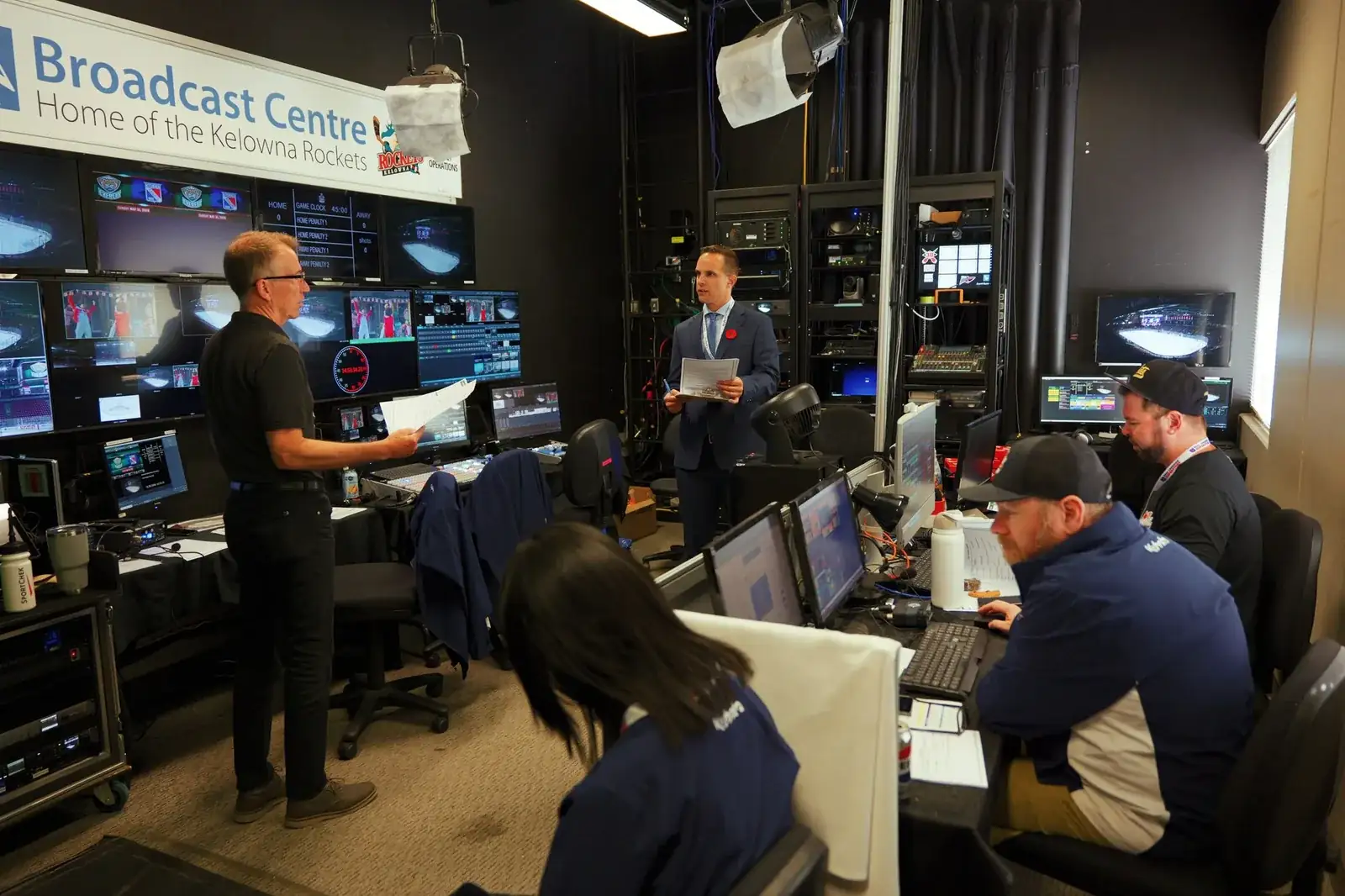
The people watching from their desks are half your audience. Plan for them at the same time as the ones in the chairs.
The online audience should be part of the show; what they see, what they hear and how they interact all need to be considered alongside the people sitting in the room.
What to plan for
- Design the event for two audiences, not one
- Strategic camera positioning to capture the best sightline in the room.
- Clean audio feed directly from the room system to the stream
- Dedicated technician monitoring the online platform
- Separate laptop/computer for remote presenters
- Remote presenters tested before the event
- Online Q&A
- Slides formatted so they work both in the room and online
- If possible and depending on the events application, avoid having remote presenters simply appear as a tiny box on a screen
- Do a complete test with the actual platform before event day, or at least a few hours prior to showtime.
What the remote audience is actually there for
Hybrid gets planned badly when nobody has decided what the stream is for. The published attendee research is helpful here because it is unflattering. Freeman's Trends Report Q1 2024, a survey of nearly 2,100 business event attendees fielded in November 2023 with a margin of error of plus or minus two points, found that seven out of ten respondents preferred to receive training and professional content in person, an increase of seven percent over the previous year, and that in person events were chosen as the most trustworthy source of information by four out of five respondents (Barbara Palmer, "What Event Attendees Want Now," PCMA Convene, January 16, 2024).
None of that is an argument against streaming. It is an argument for knowing which product you are building. The stream serves the people who could not get in the room, and it serves them well when it is designed as its own show rather than as a camera pointed at somebody else's. Ken Holsinger, Freeman's senior vice president of strategy, gave the test in the same article: "if the attendee doesn't have their objectives met, nothing else matters in the entire ecosystem." Ask what the person at their desk came for, then work backwards to the camera positions.
Hybrid is not a passing arrangement
Bizzabo, which surveyed more than 4,000 organizers and attendees in June 2023, reported separately that 68 percent of planners hoped to include a virtual component at their in person events going into 2023 (Bizzabo, "The State of In-person B2B Conferences in 2023"). Much larger round numbers circulate for how many events are now hybrid. Most trace back to nothing you can check, so they are not worth repeating in a budget conversation.
Attention online behaves differently from attention in a chair. ON24's 2025 platform benchmarks put average live engagement at 49 minutes, against 53 minutes in its 2024 report (ON24, Webinar Benchmarks 2025; ON24, 2024 Digital Engagement Benchmarks). Those are ON24's own platform numbers from a B2B webinar population rather than a survey of all events, so read them as a benchmark. Even as a benchmark they say something the agenda has to answer to: a 90 minute general session that plays well in the room is a long sit at a desk, and the remote agenda may need its own breaks marked on it.
Somebody has to be the remote audience's host
The single change that makes the biggest difference is giving the online audience a person. In the room, the emcee handles the gaps, tells people where lunch is, and covers a late start. Online, those gaps are silence over a slide. A host who talks to camera during transitions, reads the questions coming in, and says what happens next turns a feed into a broadcast. That role has to be scheduled, briefed, and rehearsed like any other on stage position, and it needs its own microphone, its own camera, and somewhere to sit that is not the back of the technicians' table.
The test before show day
Rehearsal for hybrid means rehearsing the path, not just the content. Mason Freitas, a production specialist at AVL Solutions, made the general point in Meetings Today: "if your general sessions have a lot of moving parts, there needs to be a walk-through, at least for the main players" (Rob Carey, "Setting the Stage: Expert Advice for Affordable, Effective AV and Production," Meetings Today, May 15, 2026). A hybrid session has more moving parts than any other kind, because half of them are somewhere else.
Worth testing on the actual platform, from the actual room:
- The audio path end to end, listening on the stream and not at the console
- Every remote presenter, on their own machine and their own connection
- Screen sharing from a remote presenter, which fails differently from playback in the room
- The question queue, including who reads questions out and how they reach the stage
- The recording, confirmed as running and confirmed as containing sound
- What happens when the room loses internet, and who says what while it is down