Eight Powered Zones. Four Audio Systems.One Arch Built on Sand.
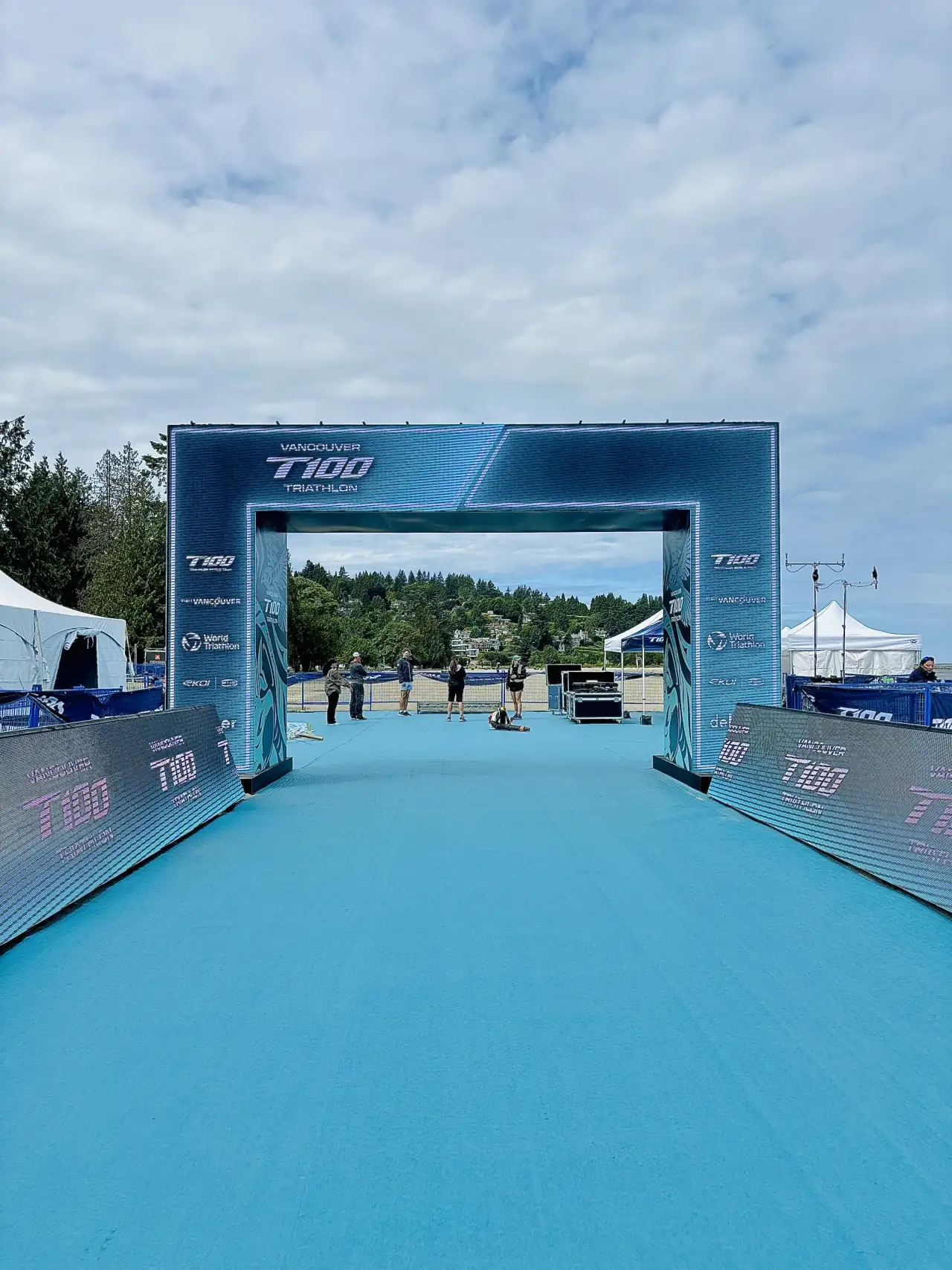
The finish arch, built on sand. 2025.
- 8Separately powered zones
- 4Independent audio systems
- 40 mPerimeter LED down the finish chute
- 5 a.m.Show start, both race days
- 11,000Participants and spectators, the Park Board's figure
01 / The Brief
A World-Tour Triathlon on a Public Beach and a Sailing Club Car Park.
Put a world-tour triathlon on a public beach and a sailing club car park, and make it work as a broadcast venue, a spectator venue and a race course at the same time.
The geography sets the problem. The swim start, transition, the finish and the awards stage are all in different places. None of them has power, and none is close enough to the others to share a sound system or a cable run.
The organisers own the race, the athletes and the broadcast. SW built the infrastructure the race happens inside: power across the site, sound in every zone, the LED, the decking and the structures.
02 / The Work
Power, Sound, LED and Decks, Zone by Zone.
Power, zone by zone
The power is organized by place rather than by equipment, and that is the shape of the job: eight separately powered zones, each with its own generation rather than one feed stretched across a beach.
The broadcast compound takes the largest share, with two generators run in parallel so it has both the capacity and the redundancy a live broadcast needs. Beyond it, the finish line, the transition lot, the box office, the swim starts, the awards stage and the equipment compound each carry their own machine, sized to what is actually there.
Distribution is the rest of the work: three-phase distro racks, panels, GFI panels at every zone, and long camlock runs between them. The site ran on a temporary electrical permit, and it ran on diesel measured in thousands of litres across the build and the two race days.
Four audio systems, not one
Audio is built as four complete systems, one each for the swim start, transition, finish, and the awards stage.
Every one of them has its own console, loudspeakers, wireless microphones and playback. Nothing depends on a neighbouring zone to make sound. A course that runs from a beach to a car park to another beach cannot be covered from one position, and a single system that fails takes the whole event with it. Four systems fail one zone at a time.
What links them is thin on purpose, so a feed can reach a zone without a copper audio run down a public beach.
The arch, and the rest of the LED
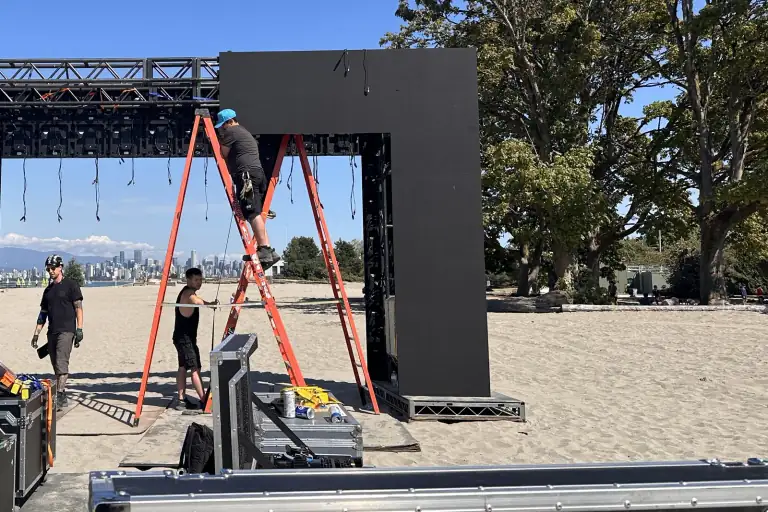
The finish arch was the crown jewel and it was built, not hired. Fine-pitch LED panels make a span across the top and run down both legs, driven by a media server. The structure under them is box truss, ballasted and standing on steel decking laid specifically to give it a base on sand.
Then it was clad. Custom walls cover the truss inside, outside, underside and top, with graphics on the gantry's panels. That is the difference between a truss arch with screens on it and a finished arch: the structure disappears and what the athlete runs through is a single object.
The rest of the LED does the work around it. Forty metres of perimeter screen line both sides of the finish chute. A lap board counts the laps. The awards backdrop is a mobile LED trailer.
Decks, structures and wayfinding
Everything an athlete or a photographer stands on was decked: an eighty-four by four foot platform at the pro swim start, a twenty-four by sixteen foot awards stage, and a photographers' deck at the finish line with its own stairs.
Through the course, truss structures mark the route and carry the graphics: crank-up arches at twenty-four feet wide, double-wide pillars, bike-in and bike-out gates at transition, and wayfinding truss at four points, each with its own printed wrap.
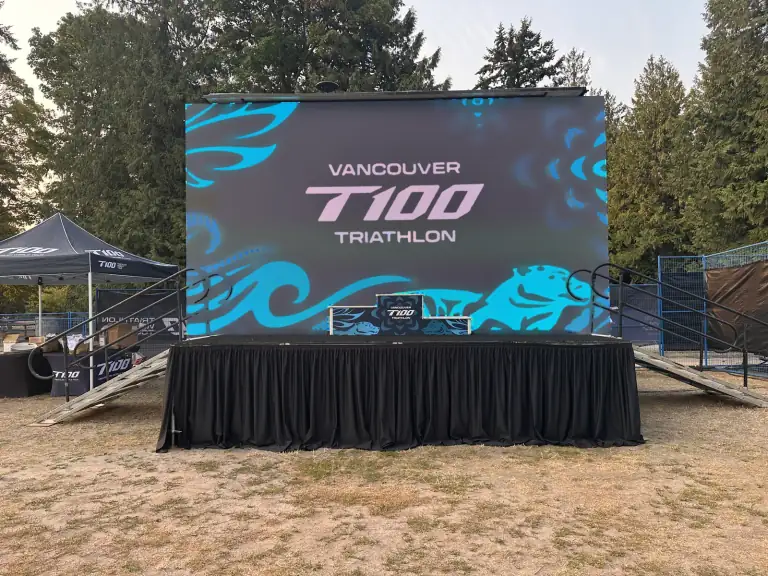
The LED wall used for the race broadcast, sponsor loops and as the backdrop for the awards stage.
03 / The Outcome
Nothing to Plug Into. Every Zone Brought Its Own.
Eight zones, four sound systems, one arch, and no building anywhere on the site.
Eight zones. Four sound systems. One arch.
No building to plug into.
So every zone brought its own.
Planning something like this?
Every event has a start time.
We make sure the technology is ready when it does. Tell us the date, the room, and what has to happen in it. You get a plan and a number back, from the people who would run it.
One of more than 4,000 events SW runs a year.